-
 仅限中国大陆学生购买。所有其他订单将被取消并退款。
 -
电子版 仅限中国大陆学生购买。所有其他订单将被取消并退款。
-
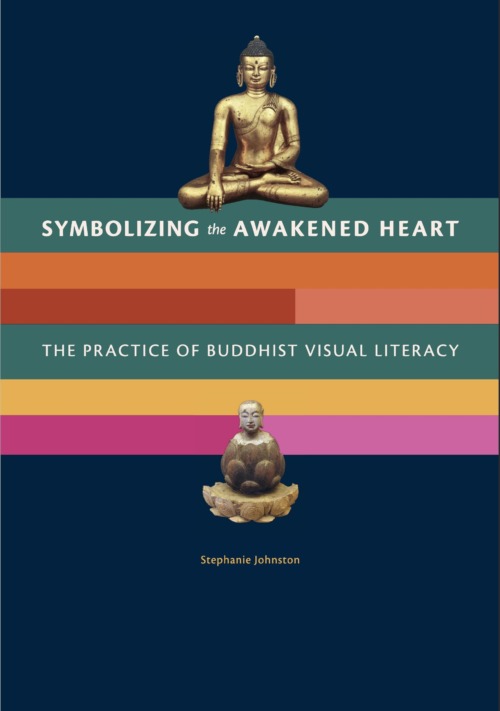 Please note, this is a digital EPUB delivered through our website. You will receive download instructions via email. About This Book The idea of this book is twofold: to lay the foundations for understanding and recognizing basic symbols of enlightenment and awakening in a Buddhist context. And, how understanding and recognizing those are processes of awakening in and of themselves. After an introduction to the topic of Buddhist visual literacy, in Part One, you will find the core skills necessary for reading art in a Buddhist way: the inevitability of symbolism, its range of use, and the mechanics in a Buddhist context. Part Two is a visual primer for identifying meaning in the symbolic elements of Buddhist art. Topics are connected in a spiral and sequential way, with key ideas being presented and refined as they are revisited and applied throughout the book. Part Three brings everything together in a hands-on application. This final layer of method guides you in experimenting, sleuthing, and applying these skills to a series of different works. This is Interactive Necessarily, this book invites you to interact. Without personally experienced exploration, the insight and inspiration that emerges from a good Buddhist art-based reading encounter, one that sparkles with awakening, can be elusive. So, topic-specific experiments, investigations, and questions appear throughout. The joy of discovery lies in engagement; as such, please allow yourself the time and space to try them out. Many are short and can be done at home or taken into the field, for instance, to a museum, a bus stop, on a walk, while shopping, into any situation, pretty much, and are more revealing when repeated over time. Contents Guide Introduction: Creativity and the Arts provides the historical and traditional landscape for Buddhist visual literacy, symbolism, and the art of creativity as a means to connect to awakening. It is grounded in the topics associated with Tibetan Buddhist higher education. Based on that grounding, Part One: The Power to Illuminate focuses on the how of art having the power to illuminate. It outlines the mechanics of meaning based on symbols. Part Two: What Does Awake Look Like? explores: What does "awake" look like, and how is it portrayed? Key episodes in Shakyamuni Buddha's life are presented to reveal the vocabulary of its symbolism, a necessity for reading Buddhist art. Part Three: Sleuthing for Awakening demonstrates how the materials from Parts One and Two work together through doing. Guided explorations and experiments bring the skills and tools of Buddhist visual literacy to bear on reading and investigating twelve different artworks. Resources provide support for this material. The contemporary teacher, artist, and writer Dzogchen Ponlop Rinpoche provides valuable context for the life of the Buddha and Buddhism. In addition, a topical bibliography is offered as an assist to further exploration and research into the ideas and themes of this book. By the end of this adventure, I hope you will have a good sense of Buddhist visual literacy in action. And, that insightful experiences and playful discoveries abound along the way, within this book and without.
 -
- The hardcopy book is shipped from the US. International customers may wish to explore local booksellers, Shambala Publications, or Amazon to save on shipping cost.
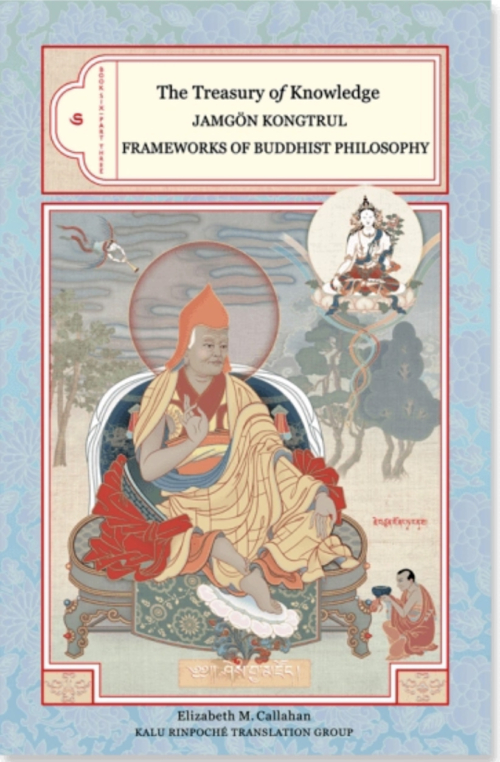
Author: Jamgön Kongtrul Lodrö Thayé Translator: Elizabeth M. Callahan
In Tibetan religious literature, Jamgön Kongtrül's Treasury of Knowledge in ten books stands out as a unique, encyclopedic masterpiece embodying the entire range of Buddhist teachings as it was preserved in Tibet. This volume, Frameworks of Buddhist Philosophy, is his masterful survey of the broad themes and subtle philosophical points found in more than fifteen hundred years of Buddhist philosophical writings. In a clear and systematic manner, he sets out the traditional framework of Buddhism's three vehicles and four philosophical systems, and provides an overview of the key points of each system. His syncretic approach, which emphasizes the strengths of each of the systems and incorporates them into a comprehensive picture of philosophical endeavor, is well-suited for scholar-practitioners who seek awakening through the combination of analytical inquiry and meditation. -
- Also available as an eBook for Apple and Android devices.
- The hardcopy book is shipped from the US. International customers may wish to explore local booksellers, Shambala Publications, or Amazon to save on shipping cost.
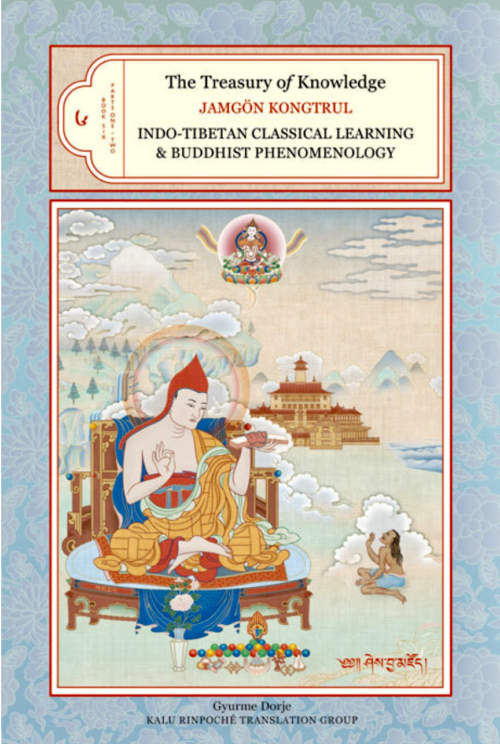
Author: Jamgön Kongtrul Lodrö Thayé Translator & Editor: Gyurme Dorje
Jamgön Kongtrul’s encyclopedic Treasury of Knowledge presents a complete account of the major lines of thought and practice that comprise Tibetan Buddhism. Among the ten books that make up this tour de force, Book Six is by far the longest—concisely summarizing the theoretical fields of knowledge to be studied prior to the cultivation of reflection and discriminative awareness. The first two parts of Book Six, contained in this volume, respectively concern Indo-Tibetan classical learning and Buddhist phenomenology. The former analyzes the traditional subjects of phonology and Sanskrit grammar, logic, fine art, and medicine, along with astrology, poetics, prosody, synonymics, and dramaturgy. The principal non-Buddhist philosophical systems of ancient India are then summarized and contrasted with the hierarchical meditative concentrations and formless absorptions through which the "summit of cyclic existence" can genuinely be attained. Part Two examines the phenomenological structures of Abhidharma—the shared inheritance of all Buddhist traditions—from three distinct perspectives, corresponding to the three successive turnings of the doctrinal wheel.