-
This is the updated Mind and Its World 3 Sourcebook for semester course and Summer Institute (not for Self-Paced Online Course).
Also available as an ebook for Apple and Google. Mind and Its World III first concludes the investigation into causes and results as presented in Collected Topics. It then turns to the analysis of the ways in which mind cognizes phenomena, particularly the ways in which conceptuality functions, by investigating the modes of engagement from Classifications of Mind and the methods that lead to cognition from Collected Topics. Selected readings, analytical meditations, study questions, and review summaries are included in the sourcebook. -
 (ESPAÑOL) Mind and Its World I begins a detailed analysis of the subjective side of experience. It examines mind and how it perceives its world in valid and invalid ways based on the Classifications of Mind, which provides divisions and definitions of the types of mind identified in the epistemological tradition of Dignaga and Dharmakirti. The key point is the discernment of the aspects of mind that validly perceive things the way they are, which are distinguished from those aspects of mind that are mistaken and tainted by fundamental delusion, and thus keep one bound in samsara. It also introduces the two Hinayana philosophical systems, the Vaibhashika and Sautrantika schools, covering the two truths and the process of perception. Selected readings, analytical meditations, study questions, review summaries are included in the sourcebook. Also available as an eBook for Apple or Android devices.
 -
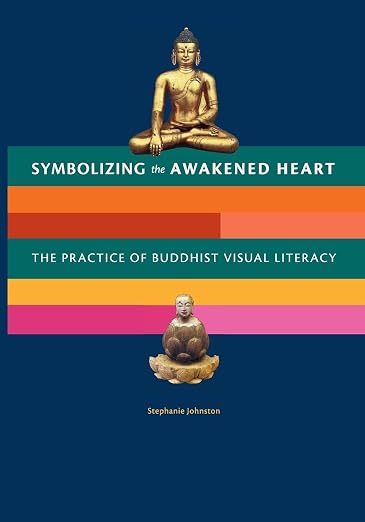 About This Book The idea of this book is twofold: to lay the found-ations for understanding and recognizing basic symbols of enlightenment and awakening in a Buddhist context. And, how understanding and recognizing those are processes of awakening in and of themselves. After an introduction to the topic of Buddhist visual literacy, in Part One you will find the core skills necessary for reading art in a Buddhist way: the inevitability of symbolism, its range of use and the mechanics of it in a Buddhist context. Part Two is a visual primer for ident-ifying meaning in the symbolic elements of Buddhist art. Topics are connected in a spiral and sequential way, with key ideas being presented and refined as they are re-visited and applied throughout the book. Part Three brings everything together in hands-on application. This final layer of method guides you in experimenting, sleuthing, and applying these skills to a series of different works. This is Interactive Necessarily, this book invites you to interact. Without personally experienced exploration the insight and inspiration that emerges from a good Buddhist art-based reading encounter, one that sparkles with awakening, can be elusive. So, topic specific experiments, investigations, and questions appear throughout. The joy of discovery lies in engagement, as such, please allow yourself the time and space to try them out. Many are short and can be done at home or taken into the field-for instance, to a museum, a bus stop, on a walk, while shopping, into any situation pretty much-and are more revealing when repeated over time. Contents Guide Introduction: Creativity and the Arts provides the historical and traditional landscape for Buddhist visual literacy, symbolism, and the art of creativity as a means to connect to awakening. It is grounded in the topics associated with Tibetan Buddhist higher education. Based in that grounding, Part One: The Power to Illuminate focuses on the how of art having the power to illuminate. It outlines the mechanics of meaning based on symbols. Part Two: What Does Awake Look Like? explores: What does awake look like and how is it portrayed? Key episodes in Shakyamuni Buddha's life are presented to reveal the vocabulary of its symbolism, a necessity for reading Buddhist art. Part Three: Sleuthing for Awakening demonstrates how the materials from Parts One and Two work together through doing. Guided explorations and experiments bring the skills and tools of Buddhist visual literacy to bear on reading and investigating twelve different artworks. Resources provides supports for this material. Valuable context for the life of the Buddha and Buddhism is given by the contemporary teacher, artist, and writer, Dzogchen Ponlop Rinpoche. In addition, a topical bibliography is offered as an assist to further exploration and research into the ideas and themes of this book. By the end of this adventure I hope you will have a good sense of Buddhist visual literacy in action. And, that insightful experiences and playful discoveries abound along the way-within this book and without.
 -

ROOT TEXT
Madhyamaka is a potent and universally accessible means of calming our suffering and awakening to our innate wisdom. The Center of the Sunlit Sky artfully rescues this brilliant teaching from its unwarranted reputation for intellectual opacity and reinstates it as a supremely practical tool kit for everyday living. The aim of this book is to take Madhyamaka out of the purely intellectual corner into which it unjustly gets boxed. It is an attempt to show how Madhayamaka actually addresses and works with all of our experiences in life. The book follows the original Indian sources as well as the standard commentaries on Madhyamaka in the Kagyu School of Tibetan Buddhism. At the same time, these materials are adapted for a contemporary audience, combining the familiar sharpness of Madhyamaka reasonings (launching a massive assault on our cherished belief systems) with exploring the practical relevance of the Madhyamaka way of mind training. Also available as an eBook for Kindle devices. Note that the hardcopy book is shipped from the US. International customers may wish to explore local booksellers or Amazon.com to save on shipping cost. -
eBook available!
A Commentary by Acharya Lama Tenpa Gyaltsen and Karl Brunnhölzl
This is a newly updated sourcebook, a set of two volumes, produced from a series of talks given by Acharya Lama Tenpa Gyaltsen at Nītārtha Institute, Gampo Abbey, Cape Breton Island, Nova Scotia, Canada, in August and September 1998, and by a series of talks given by Karl Brunnhölzl at Nītārtha Institute, Nalanda West, Seattle, Washington, United States, September, October, and November 2018.
Available as eBook:
-

佛 性 中文資料手冊 (上下冊)
BUD 630 佛性 如來的明光心 教 授 : 阿闍黎喇嘛滇巴嘉誠 Acharya Lama Tenpa Gyaltsen 卡爾‧布倫霍爾茲 Karl Brunnhölzl -

佛 性 中文资料手册 (上下册)
BUD 630 佛性 如来的明光心 第四金刚句 (上下册) 教 授 : 阿阇黎喇嘛滇巴嘉诚 Acharya Lama Tenpa Gyaltsen 卡尔·布伦霍尔兹 Karl Brunnhölzl -
- Also available as an eBook for Apple and Android devices.
- Limited supply.
- The hardcopy book is shipped from the US. International customers may wish to explore local booksellers, Shambala Publications, or Amazon to save on shipping cost.
Translator: Karl Brunnhölzl
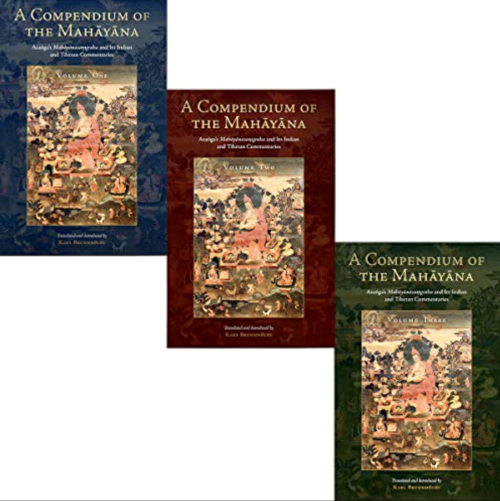
Winner of the Khyentse Foundation Prize for Outstanding Translation. The first complete English translation of Asaṅga's Mahāyānasaṃgraha, the most important and comprehensive Indian Yogācāra text, and all its available Indian commentaries. The Mahāyānasaṃgraha, published here with its Indian and Tibetan commentaries in three volumes, presents virtually everything anybody might want to know about the Yogācāra School of mahāyāna Buddhism. It discusses in detail the nature and operation of the eight kinds of consciousness, the often-misunderstood notion of “mind only” (cittamātra), dependent origination, the cultivation of the path and its fruition in terms of the four wisdoms, and the three bodies (kāyas) of a buddha. Volume 1 presents the translation of the Mahāyānasaṃgraha along with a commentary by Vasubandhu. The introduction gives an overview of the text and its Indian and Tibetan commentaries, and explains in detail two crucial elements of the Yogācāra view: the ālaya-consciousness and the afflicted mind (kliṣṭamanas). Volume 2 presents translations of the commentary by Asvabhāva and an anonymous Indian commentary on the first chapter of the text. These translations are supplemented in the endnotes by excerpts from Tibetan commentaries and related passages in other Indian and Chinese Yogācāra works. Volume 3 includes appendices with excerpts from other Indian and Chinese Yogācāra texts and supplementary materials on major Yogācāra topics in the Mahāyānasaṃgraha.