-
 Commentary on the Feast for the Fortunate Grounds 1-5 and Part I of Ground 6, by Dzogchen Ponlop Rinpoche, 2004. 387 pgs, Binder format. This is part the Nitartha Advanced Curriculum.
 -
 This expanded second edition features the profound oral commentary by Dzogchen Ponlop Rinpoche on the Saṃdhinirmocana Sūtra (Unraveling the Intent of the Buddha), a crucial sūtra for the Yogācāra tradition. This transcript now includes Rinpoche's teachings on the prologue, the first five chapters, which illuminate the five defining characteristics of ultimate reality and the presentation of the all-base consciousness, as well as Chapter Eight, which delves into the topic of meditation. Presented with remarkable clarity and detail, Rinpoche's commentary is accompanied by the oral translation of Mitra Tyler Dewar and the root text translation by Gregory Forgues. This edition is published with the generous patronage and supervision of 84000: Translating the Words of the Buddha, ensuring the accuracy and accessibility of this vital text.
 -
 If you purchased the Clear Thinking Provisional Draft, you’re eligible for a 50% discount on the 2025 edition! To redeem your discount, please use the discount code emailed to you. If you are missing your discount code, but have purchased the provisional draft, contact publications@nitartha.org.
 -
 El libro aún se está actualizando, pero el borrador está disponible para la compra y uso personal. Para comprarlo, los estudiantes DEBEN aceptar los siguientes términos: POLÍTICA DE CURSOS BORRADOR PROVISIONAL Y ACUERDO DE COMPARTIR ARCHIVOS ELECTRÓNICOS:
- El costo del Cuaderno de Trabajo de Pensamiento Claro, Borrador Provisional en formato PDF es de USD $21.95 y no es reembolsable. Este monto servirá como pago de depósito para la compra de la versión final publicada del texto. Se le emitirá un código de cupón de descuento para la compra de la versión final, válido por un año después de la publicación del texto final.
- Nota: El cupón no se puede transferir a otra persona, no se puede usar para comprar otros textos y no es válido para ninguna versión de libro electrónico.
- Usted puede usar el Cuaderno de Trabajo de Pensamiento Claro, Borrador Provisional PDF durante la duración de la clase. Sin embargo, una vez que el curso haya concluido, generalmente determinado por la expiración del acceso a las grabaciones de video y audio del curso, DEBE eliminar el archivo PDF de su computadora, así como eliminar el correo electrónico que contiene el archivo PDF adjunto.
- Si prefiere trabajar con una copia impresa de este texto, puede imprimir una copia para su uso personal y también deberá destruirla después de su uso.
- Al final del curso, enviaremos un recordatorio por correo electrónico. En ese momento, se le pedirá que confirme respondiendo al correo electrónico, indicando que el archivo PDF y la copia impresa han sido eliminados. O, también puede informarnos proactivamente que han sido eliminados enviando un correo electrónico a: publications@nitarthainstitute.org
- Si prefiere no comprar la versión final del texto, todavía está obligado a eliminar/destruir el Cuaderno de Trabajo de Pensamiento Claro, Borrador Provisional, y no se emitirá un reembolso por el pago del depósito que realizó para acceder al Cuaderno de Trabajo de Pensamiento Claro, Borrador Provisional.
- Si decide comprar este texto, esto significa plenamente que ha comprendido y acepta esta política.
- Una vez que recibamos su pedido en el sitio web, enviaremos el PDF a la dirección de correo electrónico indicada en el pedido del sitio web. Utilice el mismo correo electrónico que utilizó para registrarse en el curso de Nitartha. Por favor, permita 72 horas para el procesamiento.
- El costo del Cuaderno de Trabajo de Pensamiento Claro, Borrador Provisional en formato PDF es de USD $21.95 y no es reembolsable. Este monto servirá como pago de depósito para la compra de la versión final publicada del texto. Se le emitirá un código de cupón de descuento para la compra de la versión final, válido por un año después de la publicación del texto final.
-

电子版 仅限中国大陆学生购买。所有其他订单将被取消并退款。
新版《心與心的世界1》和《心與心的世界2》對應英文版的兩本同名手冊,兩本加起來是對堪布仁波切所著的原典《心的科學:邏輯海典心髓》的完整的釋論。新版替代2021中文版的《心的科學:邏輯海典心髓釋論》。新版按照英文版編排,並增加了阿闍黎謝拉布嘉誠的釋論,和每課後的分析式禪修和聞思題。《心與心的世界1》詳細分析作為體驗者的這個心,它如何以如實和不如實的方式感知世界,原典《心的科學:邏輯海典心髓》教導心的分類,法教源泉是陳那和法稱的量論學傳統。要點是區分哪些面向的心如實地感知現象本來的樣子,哪些面向的心是錯亂迷惑的,並束縛我們於輪回。手冊還介紹了基礎乘中有部和經部關於二諦和感知理論的宗義思想。每一課包括課外閱讀、分析式禪修、聞思題。 -
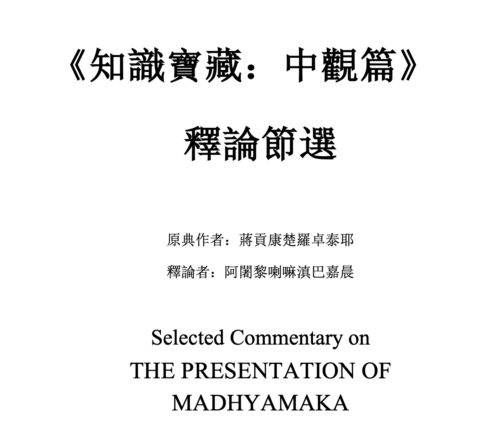
原典作者:蔣貢康楚羅卓泰耶
Author: Jamgön Kongtrül Lodrö Thayé
釋論者:阿闍黎喇嘛滇巴嘉晨 Commentary: Acharya Lama Tenpa Gyaltsen Selections from the Commentary on The Presentation of Madhyamaka in the Treasury of Knowledge中譯者:江長華 林霄Chinese Translation: Changhua Chiang & Michelle Lin -
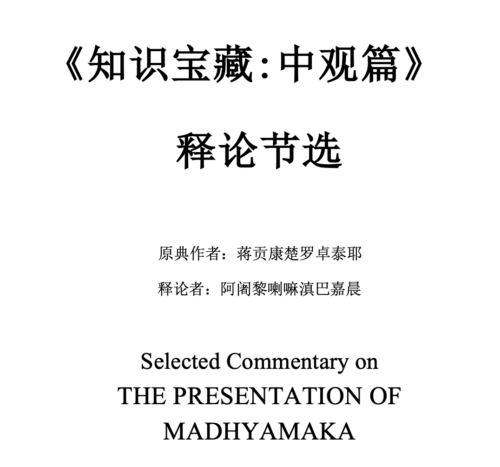
原典作者:蒋贡康楚罗卓泰耶
Author: Jamgön Kongtrül Lodrö Thayé
释论者:阿阇黎喇嘛滇巴嘉晨
Commentary by: Acharya Lama Tenpa Gyaltsen Selections from the Commentary on The Presentation of Madhyamaka in the Treasury of Knowledge中译者:江長华 林霄
Chinese Translation: Changhua Chiang & Michelle Lin Digital edition: https://publications.nitarthainstitute.org/product/%e3%80%8a%e7%9f%a5%e8%af%86%e5%ae%9d%e8%97%8f%e4%b8%ad%e8%a7%82%e7%af%87%e3%80%8b-%e9%87%8a%e8%ae%ba%e8%8a%82%e9%80%89-%e7%ae%80%e4%bd%93-selected-madhyamaka-commentary-in-tok-2/ -
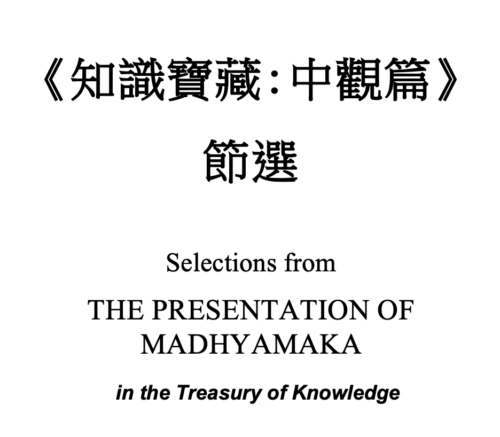
蔣貢康楚羅卓泰耶著
by Jamgön Kongtrül Lodrö Thayé
Selections from The Presentation of Madhyamaka in the Treasury of Knowledge
英譯者:Karl Brunnhölzl © 2002, 2019, 2021 了義學院 & Karl Brunnhölzl
中譯者:江長華 林霄
English translation by Karl Brunnhölzl © 2002, 2019, 2021 by Nītārtha Institute and Karl Brunnhölzl.
Chinese Translation by Changhua Chiang & Michelle Lin
-
蒋贡康楚罗卓泰耶著
by Jamgön Kongtrül Lodrö Thayé
Selections from The Presentation of Madhyamaka in the Treasury of Knowledge
英译者:Karl Brunnhölzl © 2002, 2019, 2021 了义学院 & Karl Brunnhölzl
中译者:江長华 林霄 © 2023 了义学院
English translation by Karl Brunnhölzl © 2002, 2019, 2021 by Nītārtha Institute and Karl Brunnhölzl.
Chinese Translation by Changhua Chiang & Michelle Lin
-
Commentary by Dzogchen Ponlop Rinpoche
This series explicates one of the principal Indian classics of the Madhyamaka tradition, Chandrakirti’s Madhyamakavatara (Entrance to the Middle Way), along with the Kagyü commentary by the eighth Karmapa, The Chariot of the Dakpo Kagyüs. These transcripts cover the Madhyamakavatara’s eleven chapters, which correlate with the ten bhumis (grounds) and the ten paramitas (perfections), plus the ultimate bhumi of buddhahood. The focus is particularly on the sixth chapter of the Madhyamakavatara, which discusses prajna (transcendental knowledge) and its realization of emptiness. Main topics include the selflessness of phenomena and the individual, and the impossibility of finding a self anywhere with the range of phenomenal experience. Includes root text by Chandrakirti and commentary by Mikyö Dorje, translated by Elizabeth M. Callahan. -
 Commentary: This text is published as part of the Nītārtha Institute study program directed by The Dzogchen Ponlop Rinpoche. Commentary on In Praise of Dharmadhātu © 2009 by The Dzogchen Ponlop Rinpoche and Nītārtha international. Root Text: Root stanzas from first edition draft translation of In Praise of Dharmadhātu translated by Karl Brunnhölzl. © 2005 Karl Brunnhölzl and Nītārtha Institute.
 -
Commentary by Dzogchen Ponlop Rinpoche
This series explicates one of the principal Indian classics of the Madhyamaka tradition, Chandrakirti’s Madhyamakavatara (Entrance to the Middle Way), along with the Kagyü commentary by the eighth Karmapa, The Chariot of the Dakpo Kagyüs. These transcripts cover the Madhyamakavatara’s eleven chapters, which correlate with the ten bhumis (grounds) and the ten paramitas (perfections), plus the ultimate bhumi of buddhahood. The focus is particularly on the sixth chapter of the Madhyamakavatara, which discusses prajna (transcendental knowledge) and its realization of emptiness. Main topics include the selflessness of phenomena and the individual, and the impossibility of finding a self anywhere with the range of phenomenal experience. Includes root text by Chandrakirti and commentary by Mikyö Dorje, translated by Elizabeth M. Callahan. -
This is the updated Mind and Its World 3 Sourcebook for semester course and Summer Institute (not for Self-Paced Online Course).
Also available as an ebook for Apple and Google. Mind and Its World III first concludes the investigation into causes and results as presented in Collected Topics. It then turns to the analysis of the ways in which mind cognizes phenomena, particularly the ways in which conceptuality functions, by investigating the modes of engagement from Classifications of Mind and the methods that lead to cognition from Collected Topics. Selected readings, analytical meditations, study questions, and review summaries are included in the sourcebook. -
eBook available!
A Commentary by Acharya Lama Tenpa Gyaltsen and Karl Brunnhölzl
This is a newly updated sourcebook, a set of two volumes, produced from a series of talks given by Acharya Lama Tenpa Gyaltsen at Nītārtha Institute, Gampo Abbey, Cape Breton Island, Nova Scotia, Canada, in August and September 1998, and by a series of talks given by Karl Brunnhölzl at Nītārtha Institute, Nalanda West, Seattle, Washington, United States, September, October, and November 2018.
Available as eBook:
-
- The hardcopy book is shipped from the US. International customers may wish to explore local booksellers, Shambala Publications, or Amazon to save on shipping cost.
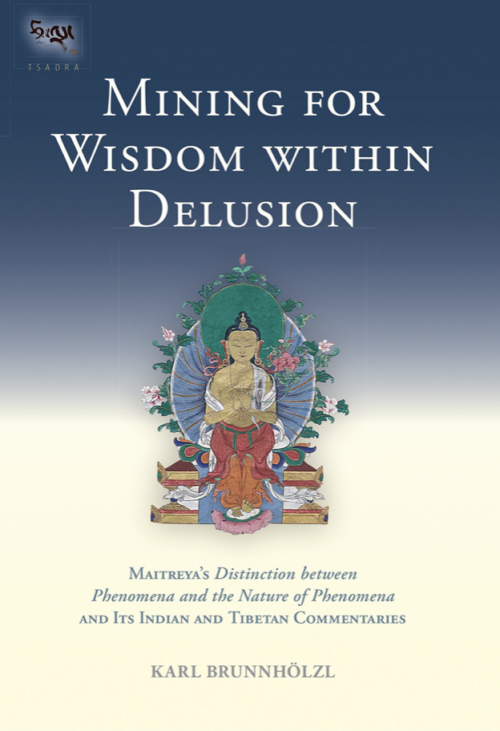
Author: Dr. Mitra Karl Brunnhölzl
Mining for Wisdom within Delusion: Maitreya's "Distinction between Phenomena and the Nature of Phenomena" and Its Indian and Tibetan Commentaries
Maitreya’s Distinction between Phenomena and the Nature of Phenomena distinguishes the illusory phenomenal world of saṃsāra produced by the confused dualistic mind from the ultimate reality that is mind’s true nature. The transition from the one to the other is the process of “mining for wisdom within delusion.” Maitreya’s text calls this “the fundamental change,” which refers to the vanishing of delusive appearances through practicing the path, thus revealing the underlying changeless nature of these appearances. In this context, the main part of the text consists of the most detailed explanation of nonconceptual wisdom—the primary driving force of the path as well as its ultimate result—in Buddhist literature. The introduction of the book discusses these two topics (fundamental change and nonconceptual wisdom) at length and shows how they are treated in a number of other Buddhist scriptures. The three translated commentaries, by Vasubandhu, the Third Karmapa, Rangjung Dorje, and Gö Lotsāwa, as well as excerpts from all other available commentaries on Maitreya’s text, put it in the larger context of the Indian Yogācāra School and further clarify its main themes. They also show how this text is not a mere scholarly document, but an essential foundation for practicing both the sūtrayāna and the vajrayāna and thus making what it describes a living experience. The book also discusses the remaining four of the five works of Maitreya, their transmission from India to Tibet, and various views about them in the Tibetan tradition. -
A commentary by Ācārya Lama Tenpa Gyaltsen
-
A commentary by Ācārya Kelsang Wangdi
-
A commentary by Āchārya Lama Tenpa Gyaltsen
This series (Introduction to Topic 8) presents Maitreya’s Ornament of Clear Realization based on the commentary by the eighth Karmapa Mikyö Dorje, Relief of the Noble Ones. Maitreya’s work is the central Mahayana text on the stages of the path and their fruition, for both the Hinayana and Mahayana. It is traditionally summarized in seventy points, or more generally in eight chapters. Whereas the Madhyamaka literature presents the explicit meaning of the Prajnaparamita Sutras, the subject matter of the Abhisamayalamkara is the hidden or implied meaning: the various stages of bodhisattvas, shravakas, and pratyekabuddhas on the path of the meditation on emptiness, from the stage of beginner up through buddhahood. Includes root text by Maitreya and commentary by Mikyö Dorje, translated by Mitra Dr. Karl Brunnhölzl. -
A commentary by Ācārya Lama Tenpa Gyaltsen
This series (Introduction to Topic 8) presents Maitreya’s Ornament of Clear Realization based on the commentary by the eighth Karmapa Mikyö Dorje, Relief of the Noble Ones. Maitreya’s work is the central Mahayana text on the stages of the path and their fruition, for both the Hinayana and Mahayana. It is traditionally summarized in seventy points, or more generally in eight chapters. Whereas the Madhyamaka literature presents the explicit meaning of the Prajnaparamita Sutras, the subject matter of the Abhisamayalamkara is the hidden or implied meaning: the various stages of bodhisattvas, shravakas, and pratyekabuddhas on the path of the meditation on emptiness, from the stage of beginner up through buddhahood. Includes root text by Maitreya and commentary by Mikyö Dorje, translated by Mitra Dr. Karl Brunnhölzl. -
A commentary by Dzogchen Ponlop Rinpoche
This series (Introduction to Topic 8) presents Maitreya’s Ornament of Clear Realization based on the commentary by the eighth Karmapa Mikyö Dorje, Relief of the Noble Ones. Maitreya’s work is the central Mahayana text on the stages of the path and their fruition, for both the Hinayana and Mahayana. It is traditionally summarized in seventy points, or more generally in eight chapters. Whereas the Madhyamaka literature presents the explicit meaning of the Prajnaparamita Sutras, the subject matter of the Abhisamayalamkara is the hidden or implied meaning: the various stages of bodhisattvas, shravakas, and pratyekabuddhas on the path of the meditation on emptiness, from the stage of beginner up through buddhahood. Includes root text by Maitreya and commentary by Mikyö Dorje, translated by Mitra Dr. Karl Brunnhölzl. -
A commentary by Dzogchen Ponlop Rinpoche
This series (Introduction to Topic 8) presents Maitreya’s Ornament of Clear Realization based on the commentary by the eighth Karmapa Mikyö Dorje, Relief of the Noble Ones. Maitreya’s work is the central Mahayana text on the stages of the path and their fruition, for both the Hinayana and Mahayana. It is traditionally summarized in seventy points, or more generally in eight chapters. Whereas the Madhyamaka literature presents the explicit meaning of the Prajnaparamita Sutras, the subject matter of the Abhisamayalamkara is the hidden or implied meaning: the various stages of bodhisattvas, shravakas, and pratyekabuddhas on the path of the meditation on emptiness, from the stage of beginner up through buddhahood. Includes root text by Maitreya and commentary by Mikyö Dorje, translated by Mitra Dr. Karl Brunnhölzl. -
A commentary on THE GATEWAY THAT REVEALS THE PHILOSOPHICAL SYSTEMS TO FRESH MINDS by Ācārya Sherab Gyaltsen.