-
 A commentary by Āchārya Lama Tenpa Gyaltsen
 -
eBook available!
A Commentary by Acharya Lama Tenpa Gyaltsen and Karl Brunnhölzl
This is a newly updated sourcebook, a set of two volumes, produced from a series of talks given by Acharya Lama Tenpa Gyaltsen at Nītārtha Institute, Gampo Abbey, Cape Breton Island, Nova Scotia, Canada, in August and September 1998, and by a series of talks given by Karl Brunnhölzl at Nītārtha Institute, Nalanda West, Seattle, Washington, United States, September, October, and November 2018.
Available as eBook:
-
- Also available as an eBook for Apple or Android devices.
- The hardcopy book is shipped from the US. International customers may wish to explore local booksellers or Amazon.com to save on shipping cost.
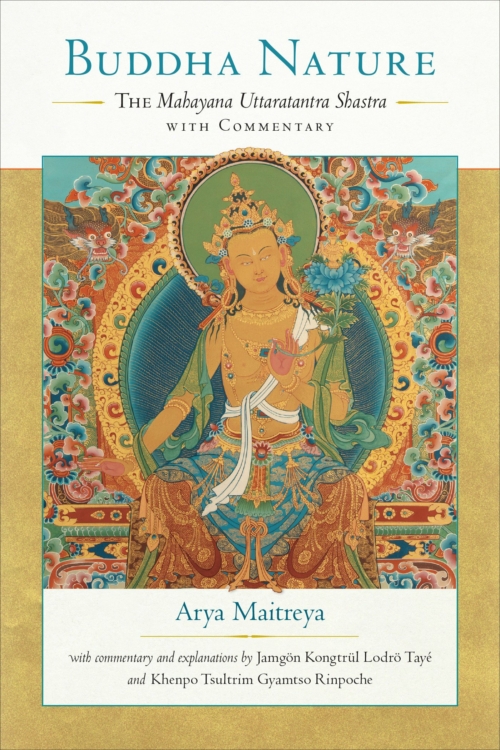
Buddha Nature: The Mahayana Uttaratantra Shastra with Commentary by Maitreya, Jamgön Kongtrül Lodrö Tayé and Khenpo Tsültrim Gyamtso Rinpoche
Author: Arya Maitreya Commentary: Jamgön Kongtrül Lodrö Tayé and Khenpo Tsültrim Gyamtso Rinpoche Translator: Rosemary Fuchs
All sentient beings, without exception, have buddha nature—the inherent purity and perfection of the mind, untouched by changing mental states. Thus there is neither any reason for conceit nor self-contempt. This is obscured by veils that are removable and do not touch the inherent purity and perfection of the nature of the mind. The Mahayana Uttaratantra Shastra, one of the “Five Treatises” said to have been dictated to Asanga by the Bodhisattva Maitreya, presents the Buddha’s definitive teachings on how we should understand this ground of enlightenment and clarifies the nature and qualities of buddhahood. This seminal text details with great clarity the view that forms the basis for Vajrayana, and especially Mahamudra, practice. -
 NOTE: For shipping within the US only. One hundred and thirteen definition flashcards drawn from the Classifications of Mind root text. English, Tibetan, and Sanskrit translations included.
 -
-
Translator: Ari Goldfield
A root text by Khenpo Tsültrim Gyamtso Rinpoche. It presents the divisions and definitions logic, and what constitutes valid and invalid reasoning as presented in the tradition of Dignāga and Dharmakīrti. -
 If you purchased the Clear Thinking Provisional Draft, you’re eligible for a 50% discount on the 2025 edition! To redeem your discount, please use the discount code emailed to you. If you are missing your discount code, but have purchased the provisional draft, contact publications@nitartha.org.
 -
 NOTE: For shipping within the US only. Ninety six definition flashcards drawn from the Collected Topics root text. English, Tibetan, and Sanskrit translations included.
 -
-
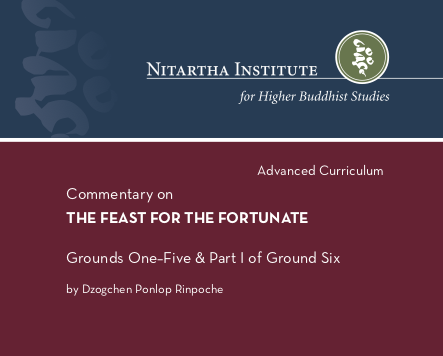 Commentary on the Feast for the Fortunate Grounds 1-5 and Part I of Ground 6, by Dzogchen Ponlop Rinpoche, 2004. 387 pgs, Binder format. This is part the Nitartha Advanced Curriculum.
 -
 The commentary, Feast for the Fortunate, is the ninth Karmapa’s abridgement of the eighth Karmapa, Mikyö Dorje’s masterpiece, The Chariot of the Takpo Kagyü Siddhas. In it readers will find previously unavailable material on the Karmapa’s Middle Way view and a rare window into a philosophically charged era of Middle Way exposition in Tibetan Buddhism. Wangchuk Dorje’s comprehensive commentary on the Indian master Chandrakirti’s seminal text, the Madhyamakavatara, is marked by eloquent poetry, vigorous and extensive analysis, and heart instructions on breaking through the veils of confusion to independently experience the true nature of things. Includes root text and commentary by the ninth Karmapa Rangjung Dorje, translated by Tyler Dewar.
 -
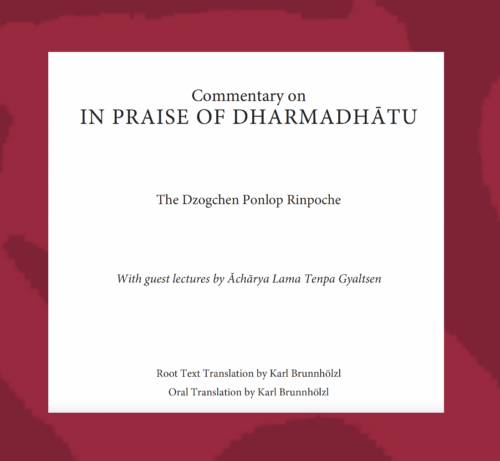 Commentary: This text is published as part of the Nītārtha Institute study program directed by The Dzogchen Ponlop Rinpoche. Commentary on In Praise of Dharmadhātu © 2009 by The Dzogchen Ponlop Rinpoche and Nītārtha international. Root Text: Root stanzas from first edition draft translation of In Praise of Dharmadhātu translated by Karl Brunnhölzl. © 2005 Karl Brunnhölzl and Nītārtha Institute.
 -
A commentary by Ācārya Lama Tenpa Gyaltsen
-
A commentary by Acharya Sherab Gyaltsen
Root verses and commentary on An Exposition Of The Presentation of the Philosophical Systems of the Great Vehicle An Exposition that Reveals the Presentation of the Philosophical Systems of the Chittamatrikas of the Great Vehicle by Dzogchen Ponlop Rinpoche. Translated by Karl Brunnhölzl, Tyler Dewar, and Scott Wellenbach. -
Commentary by Dzogchen Ponlop Rinpoche
This series explicates one of the principal Indian classics of the Madhyamaka tradition, Chandrakirti’s Madhyamakavatara (Entrance to the Middle Way), along with the Kagyü commentary by the eighth Karmapa, The Chariot of the Dakpo Kagyüs. These transcripts cover the Madhyamakavatara’s eleven chapters, which correlate with the ten bhumis (grounds) and the ten paramitas (perfections), plus the ultimate bhumi of buddhahood. The focus is particularly on the sixth chapter of the Madhyamakavatara, which discusses prajna (transcendental knowledge) and its realization of emptiness. Main topics include the selflessness of phenomena and the individual, and the impossibility of finding a self anywhere with the range of phenomenal experience. Includes root text by Chandrakirti and commentary by Mikyö Dorje, translated by Elizabeth M. Callahan. -
Commentary by Dzogchen Ponlop Rinpoche
This series explicates one of the principal Indian classics of the Madhyamaka tradition, Chandrakirti’s Madhyamakavatara (Entrance to the Middle Way), along with the Kagyü commentary by the eighth Karmapa, The Chariot of the Dakpo Kagyüs. These transcripts cover the Madhyamakavatara’s eleven chapters, which correlate with the ten bhumis (grounds) and the ten paramitas (perfections), plus the ultimate bhumi of buddhahood. The focus is particularly on the sixth chapter of the Madhyamakavatara, which discusses prajna (transcendental knowledge) and its realization of emptiness. Main topics include the selflessness of phenomena and the individual, and the impossibility of finding a self anywhere with the range of phenomenal experience. Includes root text by Chandrakirti and commentary by Mikyö Dorje, translated by Elizabeth M. Callahan. -
Commentary by Dzogchen Ponlop Rinpoche
This series explicates one of the principal Indian classics of the Madhyamaka tradition, Chandrakirti’s Madhyamakavatara (Entrance to the Middle Way), along with the Kagyü commentary by the eighth Karmapa, The Chariot of the Dakpo Kagyüs. These transcripts cover the Madhyamakavatara’s eleven chapters, which correlate with the ten bhumis (grounds) and the ten paramitas (perfections), plus the ultimate bhumi of buddhahood. The focus is particularly on the sixth chapter of the Madhyamakavatara, which discusses prajna (transcendental knowledge) and its realization of emptiness. Main topics include the selflessness of phenomena and the individual, and the impossibility of finding a self anywhere with the range of phenomenal experience. Includes root text by Chandrakirti and commentary by Mikyö Dorje, translated by Elizabeth M. Callahan. -
Commentary by Dzogchen Ponlop Rinpoche
This series explicates one of the principal Indian classics of the Madhyamaka tradition, Chandrakirti’s Madhyamakavatara (Entrance to the Middle Way), along with the Kagyü commentary by the eighth Karmapa, The Chariot of the Dakpo Kagyüs. These transcripts cover the Madhyamakavatara’s eleven chapters, which correlate with the ten bhumis (grounds) and the ten paramitas (perfections), plus the ultimate bhumi of buddhahood. The focus is particularly on the sixth chapter of the Madhyamakavatara, which discusses prajna (transcendental knowledge) and its realization of emptiness. Main topics include the selflessness of phenomena and the individual, and the impossibility of finding a self anywhere with the range of phenomenal experience. Includes root text by Chandrakirti and commentary by Mikyö Dorje, translated by Elizabeth M. Callahan. -
Author: Acharya Lama Tenpa Gyaltsen
A presentation of the philosophical tenets of the Madhyamaka tradition of the Mahayana. Based on sections of Jamgön Kongtrul’s Lodrö Thaye’s Treasury of Knowledge, this text focuses on the Madhyamaka presentation of the two truths, the views of the subschools of the tradition (Prasangika and Svatantrika), and the fundamental understanding of emptiness. Includes root text and commentary by Jamgön Kongtrul Lodrö Thaye, translated by Karl Brunnhölzl. -
A commentary by Acharya Lama Tenpa Gyaltsen and Mitra Dr. Karl Brunnhölzl.
Root text translation by Mitra Dr. Karl Brunnhölzl.
2003, 2004, & 2009 Nītārtha Institute -
 Commentary by Acharya Sherab Gyaltsen. Root Text Translation by Ari Goldfield. Oral Translation by Elizabeth M. Callahan. This transcript was produced from a series of talks given by Acharya Sherab Gyaltsen at Nitartha Institute, Gampo Abbey, Nova Scotia, Canada, in June and July 1997.
 -
This edition is no longer available.
A New and Updated Edition of this Text Is Now Available Here: https://publications.nitarthainstitute.org/product/2025-commentary-on-the-sa%e1%b9%83dhinirmocana-sutra-chapters-one-through-five-chapter-eight/ -
 This expanded second edition features the profound oral commentary by Dzogchen Ponlop Rinpoche on the Saṃdhinirmocana Sūtra (Unraveling the Intent of the Buddha), a crucial sūtra for the Yogācāra tradition. This transcript now includes Rinpoche's teachings on the prologue, the first five chapters, which illuminate the five defining characteristics of ultimate reality and the presentation of the all-base consciousness, as well as Chapter Eight, which delves into the topic of meditation. Presented with remarkable clarity and detail, Rinpoche's commentary is accompanied by the oral translation of Mitra Tyler Dewar and the root text translation by Gregory Forgues. This edition is published with the generous patronage and supervision of 84000: Translating the Words of the Buddha, ensuring the accuracy and accessibility of this vital text.
 -
 A commentary by Dzogchen Ponlop Rinpoche.